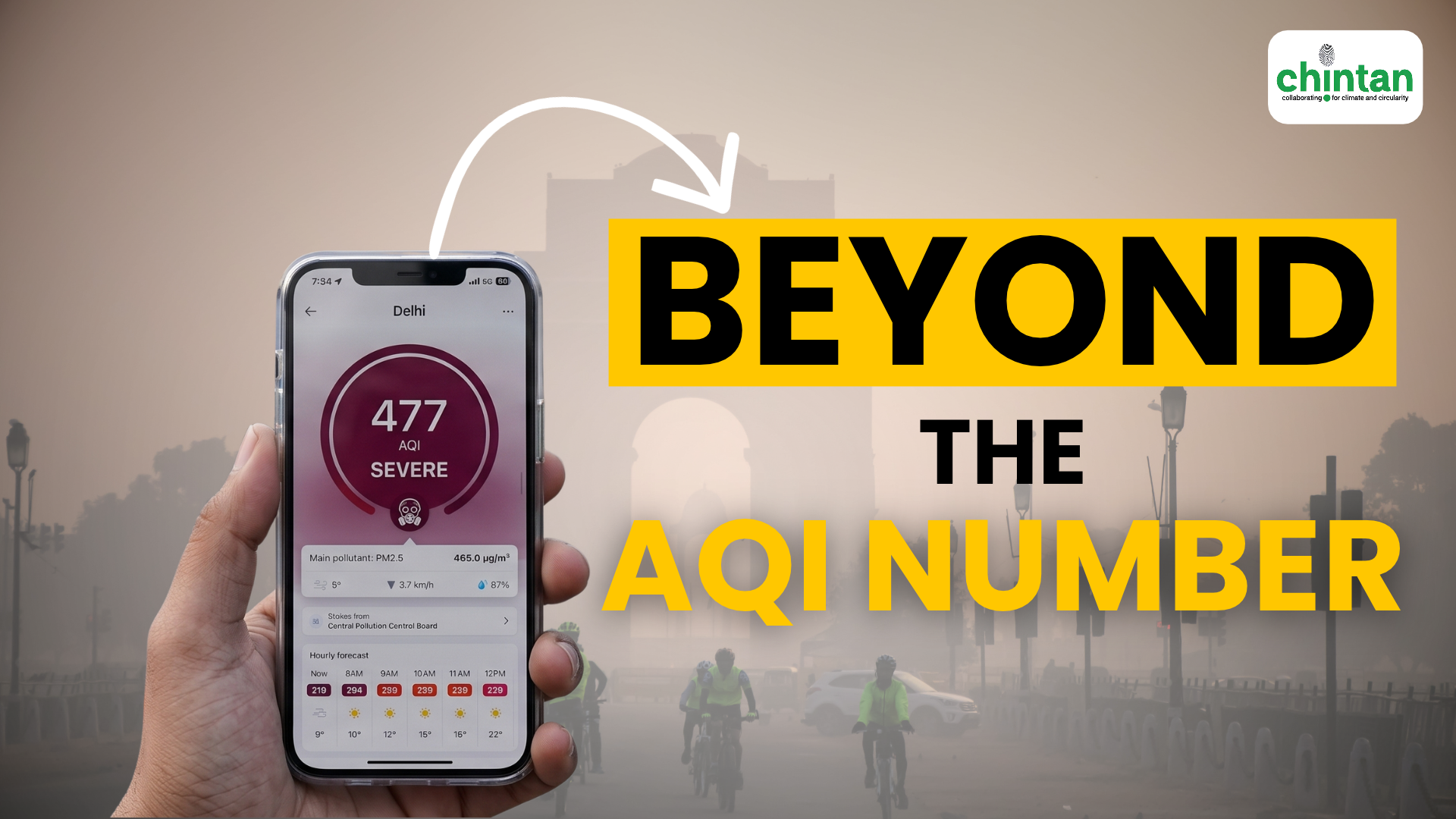
The Air Quality Index gives you a number to describe the air you breathe. But step away from the citywide reading, and the picture becomes more complicated. The pollutants around you, the time you spend exposed to them, and the limits of the monitoring network all matter.

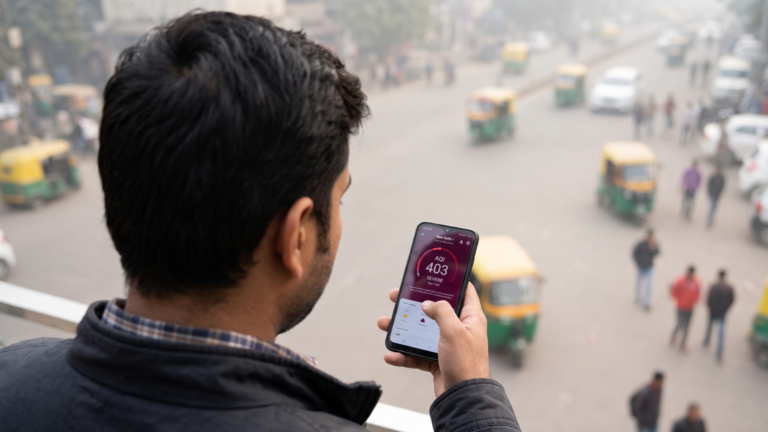
You check the Air Quality Index (AQI) before stepping outside. The number is high, the colour is alarming, and your phone tells you the air is unhealthy. You put on a mask and head to work.

But your journey takes you along a congested road, past a construction site and through a neighbourhood where waste is regularly burned. Does that single AQI number tell you what you are breathing at each stop? Not entirely.

Delhi’s AQI is an important public-health tool. It translates measurements of several pollutants into a number that is relatively easy to understand. India’s National AQI framework considers pollutants including PM2.5, PM10, nitrogen dioxide, ozone, sulphur dioxide, carbon monoxide, ammonia and lead. The overall index is determined by the highest pollutant sub-index among those for which sufficient data are available.

The problem is not that the AQI tells you nothing. It is that a single number cannot tell you everything.

"The problem is not that the AQI tells you nothing. It is that a single number cannot tell you everything."

One city, different kinds of pollution

Imagine beginning your morning beside a busy traffic intersection. Vehicles accelerate, brake and idle in queues. Their exhaust contains nitrogen oxides and fine particles, while tyres and brakes release particles and moving vehicles stir up road dust.

Nitrogen dioxide (NO2), a gas associated with combustion, is particularly relevant near busy roads. PM2.5 — particulate matter measuring 2.5 micrometres or less in diameter — can penetrate deep into the lungs. Its sources include vehicles, industry, combustion and chemical reactions in the atmosphere.

Now imagine spending the afternoon near a construction site. Dust from excavation, demolition and material handling can increase particulate pollution, including PM10. Later, you pass a spot where rubbish is burning. The smoke can contain fine particles, gases and black carbon, a soot-like pollutant produced by incomplete combustion.

These sources overlap, and pollution travels beyond the places where it originates. Nevertheless, the mix and concentration can differ from one location to another.

Chintan Environmental Research and Action Group makes the case for more localised monitoring in its 2025 report, Pollution Ka Solution. The report calls for air-quality data that are “more granular, real-time, and sector-specific.” It argues that such information can help identify localised pollution hotspots and improve responses to different sources.

This matters because a monitoring station near a major road may record a different pollution profile from one in a residential neighbourhood. Neither reading necessarily represents every street around it.

The AQI doesn't tell you everything

What happens when the pollutant is missing from the number?

Consider black carbon. You may never see it listed separately on your AQI app, yet it is an important component of combustion-related air pollution. Produced by the incomplete burning of diesel, coal, biomass and other fuels, it contributes to atmospheric warming and is associated with harmful health effects.

The absence of a separate black-carbon reading from the standard AQI does not mean the pollutant is harmless or irrelevant. It means that the overall index is not a complete inventory of everything in the air.

"The absence of a separate black-carbon reading from the standard AQI does not mean the pollutant is harmless or irrelevant. It means that the overall index is not a complete inventory of everything in the air."

Ozone presents another complication. Unlike pollutants emitted directly by vehicles or industrial sources, ground-level ozone forms through chemical reactions involving nitrogen oxides and volatile organic compounds in sunlight. Its concentrations can rise during sunny conditions, meaning the pollution mixture on a hot afternoon may differ from that on a cold winter morning.

The AQI does include ozone, but an overall score does not necessarily communicate which pollutant is dominant or how its concentration changes through the day. Two places can have similar AQI readings while experiencing different pollutant mixtures.

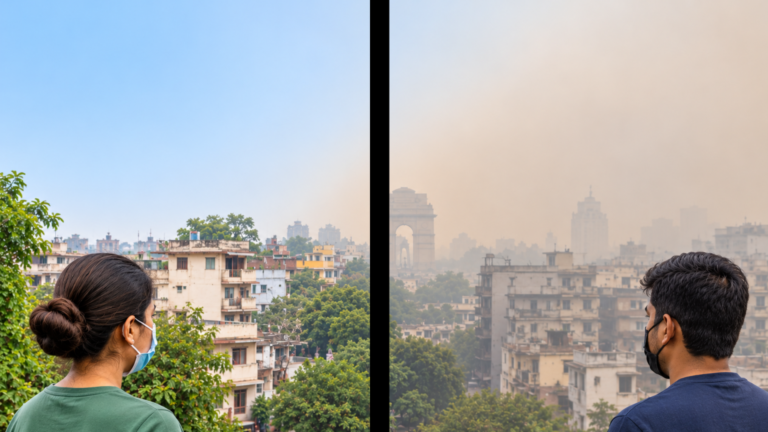
Different parts of the same city can have different levels of air pollution exposure.

Your exposure is more than the air outside

Now consider your daily routine. You might spend an hour commuting beside heavy traffic, eight hours working indoors and several more hours at home. Someone else might work outdoors near a road or construction site for most of the day.

Even if you live in the same part of Delhi, your exposure may differ considerably.

"Even if you live in the same part of Delhi, your exposure may differ considerably."

The concentration of pollution matters, but so does the time you spend breathing it and your breathing rate. A citywide AQI cannot account for your route, the hours you spend at a traffic intersection, the ventilation at your workplace or the pollution entering your home.

Chintan’s Pollution Ka Solution makes a related point: “Air pollution in Delhi does not affect all residents equally.” Its discussion of public-health communication highlights the vulnerability of outdoor workers, children, women in low-income households and residents of informal settlements.

The report also identifies “a gap between data availability and public understanding.” Even when air-quality information is available, people may not know which pollutants are being measured, what the numbers mean or how pollution affects them in their everyday environments.

That gap matters. An AQI reading can warn you about unhealthy air, but it cannot tell you precisely what you have inhaled over an entire day.

Beyond the number

Delhi’s monitoring network provides valuable information, but fixed stations measure conditions at particular locations. They cannot automatically represent every street, industrial cluster or waste-burning hotspot across the city.

Chintan’s call for more granular monitoring points towards a more useful approach: expand monitoring coverage, make pollutant-specific information easier to access and map local pollution sources more effectively. Mobile monitoring and detailed exposure assessments can further help researchers understand how pollution changes across locations and times of day.

Better data, however, are only part of the answer. They must lead to action against the sources responsible: controlling vehicle emissions, reducing construction dust, regulating industrial pollution and preventing open waste burning.

So, should you stop checking the AQI? Absolutely not. It remains a useful warning system. But treat it as the beginning of the conversation, not the end.

When you check the number tomorrow morning, remember what it can and cannot tell you. It offers a snapshot of air quality based on available measurements. It cannot fully describe the air along your route, every pollutant you encounter or the cumulative exposure you experience over a day.

The air you breathe is local, personal and constantly changing. Our understanding of it must be, too.

Similar

admin

October 15, 2003

admin

April 16, 2004

admin

September 16, 2004