In Delhi’s cramped neighbourhoods, keeping homes cool is often about insulation, fans and cool roofs—but one simple solution is frequently overlooked: ventilation. By helping hot air escape and allowing cooler air to move through the room, better airflow could offer low-cost relief from extreme heat, especially for households with limited access to mechanical cooling.

When a home becomes unbearably hot in Delhi, the usual solutions are familiar: paint the roof white, put up insulation, switch on a fan, buy a cooler or, if the household can afford it, turn on an air-conditioner.

But there is another, older and simpler question that is often overlooked: where does the hot air go?

In Delhi’s densely populated settlements, the answer is often nowhere.

Dr Anshu Sharma, co-founder of Seeds Technical Services (STS), describes the problem through the work his organisation is undertaking in collaboration with Chintan Environmental Research and Action Group in Dakshinpuri, Delhi. The project is looking at ways to reduce heat exposure inside homes, including both insulation and ventilation interventions.

“Usually, what we do is cool spaces,” Sharma says. “But if we also want to save energy and have focused attention, we want to ensure that there is cooling around the person, even if the rest of the building is not as cool.”

That distinction matters in homes where air-conditioners are out of reach and even the use of coolers or fans adds to household expenditure.

Heat enters a small house in several ways. The roof is often the biggest source. As it heats up in the sun, it transfers heat downwards through radiation. At the same time, the air inside the room heats up. That hot air rises and, if there is nowhere for it to escape, remains trapped.

Working alongside the on-ground team at Chintan, Sharma’s team has been measuring this vertical difference in temperature inside homes using data loggers placed at different heights: near the ceiling, at standing head height, at sitting head height and close to the floor.

The measurements show that the air near the floor can be significantly cooler than the air near the ceiling. During extreme heat, Sharma says, the team has measured a 5–7°C difference between the two levels. That figure represents the combined effect of the insulation and ventilation interventions being tested, rather than ventilation alone.

Data loggers are place at various heights inside homes to measure the vertical diffreence in temperatures.

The finding points to a basic feature of hot-air movement: if the hottest air accumulates near the ceiling, removing it can change the conditions in the part of the room where people actually live, sit and sleep.

The principle is straightforward. Create an opening high on the wall, close to the ceiling, through which hot air can escape. Then create another opening lower down, preferably on the opposite side, through which air can enter.

In an ideal building, this could happen naturally through cross-ventilation — air entering from one side, moving through the room and leaving through another opening.

But ideal buildings are not what Sharma’s team is working with.

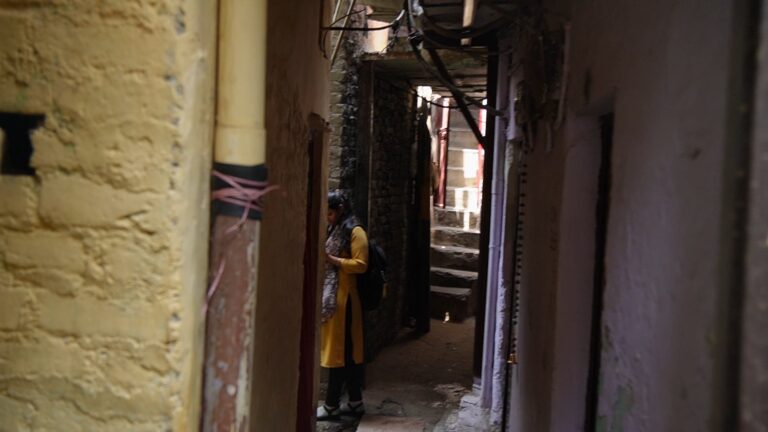
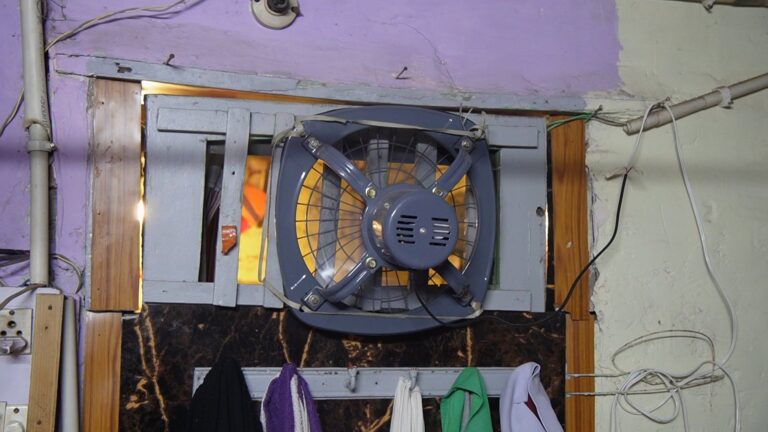
“In these settlements, there is no open space,” he says. Homes are tightly packed, often leaving little room for air to move naturally between buildings. So the project is experimenting with small exhaust fans placed high on walls to extract hot air, while using lower openings — such as a grill, small window or open door — to allow air to enter.

Narrow lanes of Dakshinpuri limit natural airflow, making ventilation challenging

The objective is not necessarily to make the entire house cold. It is to create enough movement of air around the person to provide relief.

There is another reason this matters, particularly when Delhi’s temperatures remain high while humidity rises.

The human body cools itself partly by sweating. But sweat only cools us when it evaporates. According to Dr. Vikas, who heads the health and climate work at Chintan, when air moves across the body, it can take moisture away from the skin. The air then becomes warmer and moves upwards, while more air replaces it.

This becomes especially relevant during humid weather, when sweat does not evaporate as easily. The temperature may be lower than the peak of May, but high humidity can continue to make conditions uncomfortable and reduce the body’s ability to cool itself.

This is why ventilation should not be confused simply with opening a window. Air movement, air exchange and heat insulation are different things, even though they work together.

An exhaust fan installed by Chintan and STS in one of the homes in Dakshinpuri

For low-income households however, the room for implementing these is particularly limited. Poorer households often live in housing with substandard thermal protection and have fewer resources to invest in cooling. Heat is therefore not only an environmental problem but also an economic one: people with fewer options are more exposed to it.

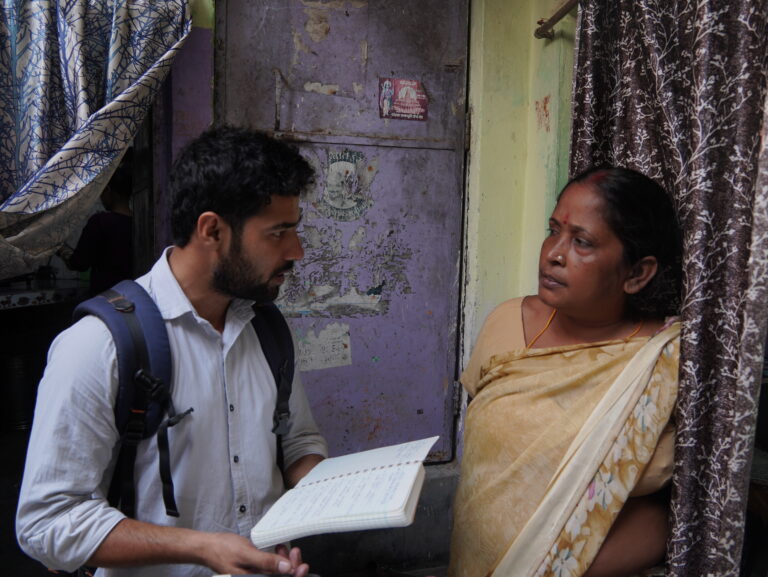
The initiative by Chintan and STS is testing whether some of those options can be made relatively affordable. The current study covers 500 houses in total — 250 receiving the intervention and 250 serving as comparison houses. The team is also measuring health impacts alongside indoor conditions.

Chintan and STS have conducted a survey of 500 households to test the heat impact and solutions required

The costs of interventions vary depending on the house and the solution. Sharma puts the broad range at around ₹2,000 to ₹7,000, with insulation generally costing more than simply painting a roof white. He sees insulation as a more durable investment, although it still requires some maintenance.

The Delhi government’s heat planning documents increasingly recognise this kind of approach. The Delhi Heat Wave Action Plan has called for building bye-laws to incorporate passive ventilation and cool-roof technologies to improve thermal comfort, particularly in more vulnerable areas. The 2025 plan similarly calls for passive building-design strategies as part of maintaining thermally comfortable indoor environments.

The larger question, then, is not whether ventilation can replace insulation, fans or other cooling measures. It cannot.

It is whether ventilation deserves to be treated as one of the basic building blocks of keeping people cool — particularly for households that cannot simply buy their way out of extreme heat.

A roof can be insulated. A wall can be shaded. A fan can move air. But if the hottest air has nowhere to escape, the room can continue to hold onto the heat.

For households living through Delhi’s increasingly hot summers with limited resources, perhaps one of the simplest questions to ask is also one of the most fundamental:

Where does the hot air go?

Similar

admin

October 15, 2003

admin

April 16, 2004

admin

September 16, 2004